Strategic
Alliances – Part two
Compoundings
Magazine
November,
2001
By
Thomas F. Glenn, Petroleum Trends
International, Inc.
and
Kevin J. Fiala, Bywater Corporate Development

This two-part article, written by
PetroTrends and its alliance partner Bywater Corporate
Development Services, provides information on what
alliances are and how independent lubricant
manufacturers can use them to grow their businesses.
Part I, appearing in the October issue of Compoundings,
focused on the concepts of alliances. Part II bring the
issue home, and speaks directly to how independent
lubricant manufacturers can make alliances work for
them.
As discussed in Part I in this
series on alliances, the lubricants business has changed
significantly over the last decade and more change is on
the way. These changes have and will continue to present
both challenges and business opportunities for
independent lubricant manufactures. Strategic
alliances provide independents with a flexible,
relatively low risk and cost effective strategy to use
in pursuit of some of the business opportunities in
today’s market.
Two
of the most common reasons for forming alliances are to
accelerate growth and to gain access to core
capabilities. They offer particularly attractive
solutions to independent lubricant manufactures when
there are strategic gaps in critical differential
capabilities that are too expensive or will take too
long to develop internally. The following represent just
some of the alliances that have been consummated and/or
explored by independent lubricant manufactures:
Lube manufacturer with filter
manufacturer to fill product gap – A lube manufacturer has established a strategic
alliance with a filter paper manufacturer to better
serve its industrial customers. By providing a product
that can be customized to suit its customers’ specific
needs, the lube manufacturer establishes a
differentiator and another way to keep competition out.
Lubricant
manufacturer with another lube manufacturer to fill
geographic gap – Given the competitive nature
among many of the independent lube manufactures, there
are a limited number of examples of two blenders
partnering. However, there are cases where two
manufacturers from different geographical areas partner
to bid on a larger regional account.
Lubricant
manufacturer with environmental clean-up company to fill
service gap – Working in conjunction with its
alliance partner, a lubricant manufacturer can offer
waste oil disposal and hazardous chemical clean-up
services to its customers.
Lube manufacture with another lubricant manufactures
to fill product gap – Brand XYZ distributor has a customer that wants ABC’s brand of oil.
In these cases, XYZ distributor can partner with an ABC
brand distributor, typically out of XYZ’s geographic
market, to fill the customer’s need. These alliances
typically involve synthetic lubricants and other
specialty lubricant products.
Lube manufacturer with a lubricant distributor
– Lubricant distributor interested in reducing its
dependence on a consolidating pool of major suppliers
allies with an independent lubricant manufacture to
obtain a private label product. The independent benefits
from the business and may have an opportunity to the
leverage distributor’s distribution network.
Lube manufacturer with an equipment management company
– An independent lube manufacturer forms an alliance
with an equipment management company in an effort to
leverage its access to channels and its customer’s
reliance on them for product recommendation. In return,
the equipment management company benefits from the lube
manufacturer’s expertise, product development and
trouble shooting capabilities.
Lube manufacturer with an original equipment manufacturer
(OEM) – Alliance can assist equipment owners optimize component
life and machine uptime. Typically includes predictive
and preventive maintenance programs, technical service,
fluid management and other lubricant and engineering
related services offered jointly by the OEM and lube
supplier.
In addition to the types of alliances highlighted above,
alliancing opportunities exist in:
- Packaging
- Laboratory
services
- Toll
manufacturing
- Chemical
management
- Cleaning
products and other lubricant related products
- Transportation
management
- International
trade partners
Now that we have highlighted just some of the destinations
alliances can take us. The next questions is what is the
best way to get there and how?
OVERVIEW OF APPROACH
TO ALLIANCING
Past
experience suggest that the journey of alliancing must
begin with a clear business need for all parties, that a
set of shared goals and shared values must be agreed
upon, that an integrated planning process is employed,
all of which is underpinned by a common measures model.
These concepts are the foundation of the
PetroTrends-Bywater approach to establishing winning
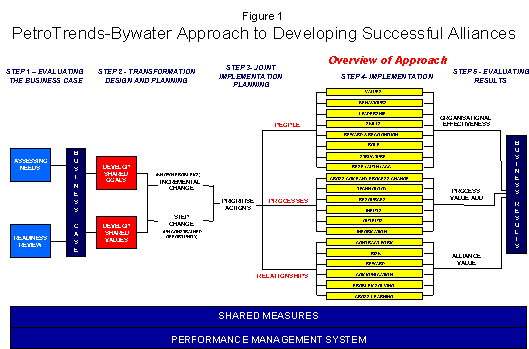
alliances that deliver step changes in performance. Figure 1 provides an overview of
our Five-Step approach. A sampling of key activities in
each Step of our alliancing process is revived in the
remainder of this article.
STEP
1: EVALUATING THE BUSINESS CASE
In the 1990’s, General
Motors Corporation made headlines by demanding
double-digit price cuts, breaking long-term contracts
and sharing information with rivals in a quest for lower
bids. It focused on price alone with its suppliers –
it ignored total costs. In the end, GM polarized its
suppliers and lost market share.
Companies
so often claim to want to get closer to their suppliers
and customers, but when asked if they’ll share
information or amend their strategy, they say that they
cannot trust the other party in doing that. This is
especially true when the potential alliance partner is
also a competitor, as is the case with many ILMA
members. (Note that an estimated 50% of alliances in
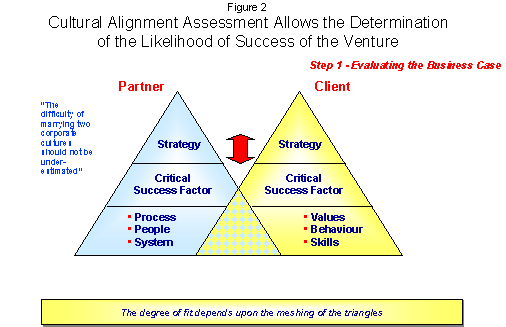
existence today are between competitors.) The difficulty
of marrying two corporate cultures has even led one U.S.
corporation to amend its policy: ‘We don’t do
alliancing any more – we never get the benefits we
know are there. If they’re strategic we buy them.’
Summary
of key activities in Step 1:
n
Clarify the compelling business need for
developing an alliance partnership.
n
Assess how the project or contract fits with
potential alliance partner’s strategies.
n
Assess the prevailing cultural norms and
operating style of potential alliance partners – cultural
profiling (see Figure 2).
n
Select partner or partners
STEPS
2 & 3: TRANSFORMATION DESIGN AND PLANNING &
JOINT IMPLEMENTATION PLANNING
If
where you are trying to get to with the alliance is
clear –
the shared goals – the planning is the task of saying what
you will do to get you there. It has two elements:
n
Known Problems (Incremental Change): Involves
listing down all the known areas of difficulty or
problem, and then defining what would be needed by all
parties to put these problems right.
n
Unconstrained Opportunities (Step-Changes): Like
the supplier who says he’ll move his factory and put
it next to the customer. Or the customer that bases his
QA staff at the supplier’s factory. Or where R&D
of the two firms is merged together.
What is important about
the planning process is that it is open, done jointly,
and that known problems and unconstrained opportunities
are discussed separately. If not, the debate quickly
reverts to the known, rather than searching for the
greater potential that is the unknown.
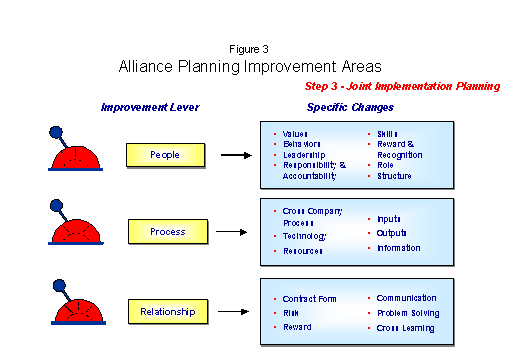
But what type of
improvements are we talking about? The types of areas
that need to be reviewed in the planning process are
shown in Figure 3.
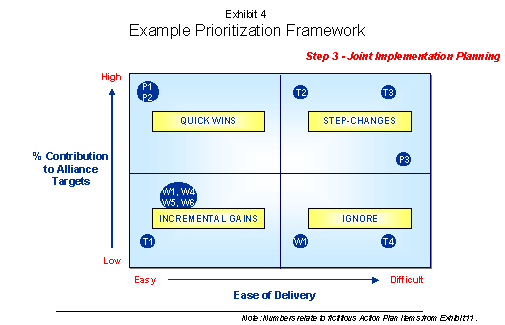
Alliancing,
like any change program, needs early wins to provide
confidence to both parties that this was a good route to
go down. As shown in Figure 4, prioritizing the
opportunities identified by the planning process, and
then using that as the basis to set out a joint action
plan ensures some of the “low hanging fruit” is
picked first, before setting off up Mount Everest
together.
Summary
of key activities in Step 3:
n
Develop a common vision built upon the individual
aspirations of each alliance partner and upon shared
goals and values.
n
Assess gaps in the cultural profiles, performance
standards, values and behavioural norms that need to be
addressed.
n
Develop clear performance targets for the project
or contract and commit to actions.
n
Translate stretch targets into a series of
detailed plans.
n
Develop joint organization structures for the
project or contract and plans to deliver the targets.
n
Develop joint delivery processes.
n
Agree risk and reward structure and the
relationship management process.
n
Develop a series of shard performance measure and
a common measurement system.
STEPS
4 & 5: IMPLEMENTATION & EVALUATING RESULTS
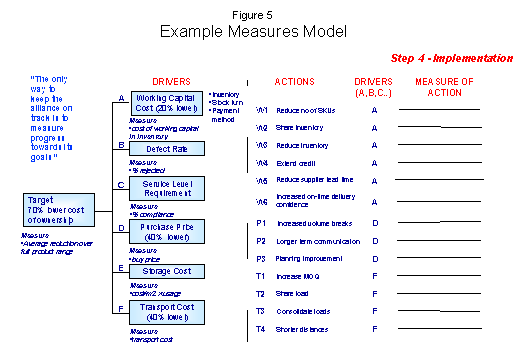
If measures are the
glue that holds organizations together, then their
importance when dealing with multiple companies is even
greater. If shared goals, values and actions have been
agreed, the only way to keep the alliance on track is to
measure progress towards them. However, the construction
of a measures model for an alliance is subtly different
to that of a company. The purpose of a particular
alliance tends to be far more focused than that of a
company. Where a Balanced Scorecard approach is
extremely useful for firms, it can lose the overriding
strategic imperative in an alliance.
Take an R&D
alliance in the aerospace industry. It exists to design
a new plane within a certain cost and timeframe. Another
example is a topside alliance in the oil industry. Its
primary aim is maximum production (topside efficiency)
for minimum operating cost. That’s it. The operator of
that oil platform may have many other considerations.
And they have the whole asset to think about, not just
topside. But for the alliance, it is those two strategic
measures that matter.
Therefore, we have
found that a cascade measures model driven from the two
or three strategic measures defining the purpose of the
alliance is most effective, as shown in Figure 5. Lower
level measures, which link root-cause elements to the
strategic goals are then the order of the day. But
keeping the whole thing simple and focused is the
absolute key to success. As is, of course, all parties
viewing those measures in the same way from the same
data.
Summary
of key activities in Steps 4 & 5:
n
Install the common measurement system.
n
Follow up on key personnel to ensure data is
routinely gathered to populate the common measurement
system.
n
Monitor progress and effectiveness of
implementation plans.
n
Conduct regular performance reviews against the
targets to drive out improvement actions.
n
Develop an effective and practical process for
capturing lessons learned and concluding key phases of
the project or contract.
n
Enable constructive feedback and sharing of the
learning amongst the alliance partners.
n
Implement facilitated assessments with each
participant.
n
Employ joint workshop with both departing and
remaining partners.
LESSONS
LEARNED
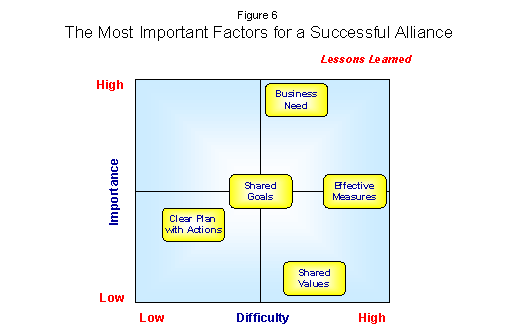
Based
on past assignments and research conducted by
PetroTrends and Bywater’s on alliancing, we have
summarized some of our key learnings below. The
learnings are segmented into five categories and each of
these categories is plotted by “Difficulty to
Achieve” and “Importance to a Successful Alliance”
in Figure 6.
1.
Business Need
n
Identified
as the most important pre-requisite for a successful
alliance.
n
Tends
to be a subjective debate amongst participants.
2.
Effective Measures
n
Identified
as the most difficult area.
n
Must
be clearly linked with the shared goals and planning
activities for the alliance.
n
The
cascaded measures model is far more effective than the
balanced score card approach.
3.
Shared Values
n
Identified
as difficult to achieve but not so important.
n
Experience
shows most failures occur where values are miss-aligned.
4.
Shared Goals
n
Identified
as a medium priority in the importance matrix.
n
Joint
goal setting workshops with alliance partners have been
successful mechanism.
5.
Clear Plan with Actions
n
Leadership
structure is important.
n
Link
between activities (making it happen) and the plan is
the most difficult area.
n
Building
trust between participants is critical.
n
Participants
need a structure to openly share known and historic
problems.
n
Participants
bring baggage and need help to leave it behind.
n
Most
participants are both unfamiliar and uncomfortable with
step change planning and need structure and support.
n
Forcing
step change planning really tests commitment to the
business case.
n
How
to enable step-change planning when most participants
are grossly uncomfortable with it?
ALLIANCING CHECKLISTS
Whether you are
about to embark, are on the road, or just pulling in for
your first pit stop, the critical factor in alliancing
is recognizing it is a journey, not a one off project.
And to embark on a journey, one must have a map, and
have shown it to fellow travelers. As with all journeys,
you are never quite sure what you will find along the
way, even if you have a clear view of where you are
heading. That is why establishing mutual trust,
understanding and confidence with your fellow companions
is key before ever setting off. And if you do decide to
set off, PetroTrends and Bywater Corporate Development
Services hope the planning checklists below are helpful
to you.
Choosing a Partner
o
Is the proposed alliance activity or process strategic in
nature?
o
Have you conducted a capability assessment of all potential
parties? Have you picked the winner?
o
For your chosen partner, have both companies done a cultural
assessment to identify areas of difference?
o
Is there a clearly identified business need for both parties?
o
Has a business case been constructed which identifies the
benefits of the alliance?
o
Do both parties have similar experiences of alliancing? Is
there a common level of maturity?
o Would you hire their
managers to run your business?
Ready
to Go?
o
Do you have a set of shared goals?
o
Do both parties have a common view of success and failure?
o
Have you developed a statement of values which dictates how
you will work together?
o
Is the measures model built?
o
Have you agreed how you will report and review progress
towards these measures?
o
Have you defined the organizational structure of the
alliance?
o
Have clear stretch targets been set which align to both
companies’ corporate strategies?
o
How would you rate the trust you have in your partner on a
scale of 1 to 10?
o
Have you agreed how to share the losses if something goes
wrong?
On
The Road
o Do you have a mechanism
for escalating problems which cannot be resolved within
the operational alliance structure?
o
Are you focused on delivering some quick wins?
o
Do individuals in both companies get rewarded on alliance
performance or parent company performance?
o
Is there an effective communications process being used?
o
Has integrated planning become the way of setting direction,
or do both firms plan separately?
o
Are there clear milestones and objectives which are regularly
reviewed?
o
Is there a mechanism for a pit-stop, i.e., a chance to stand
back, take stock, and then drive forward again?
|